The Air Force Let AI Fly an F-16. The Pilot Was Just Watching.
Last month a combat fighter jet flew autonomously over Florida. The program is designed to scale across the whole fleet.
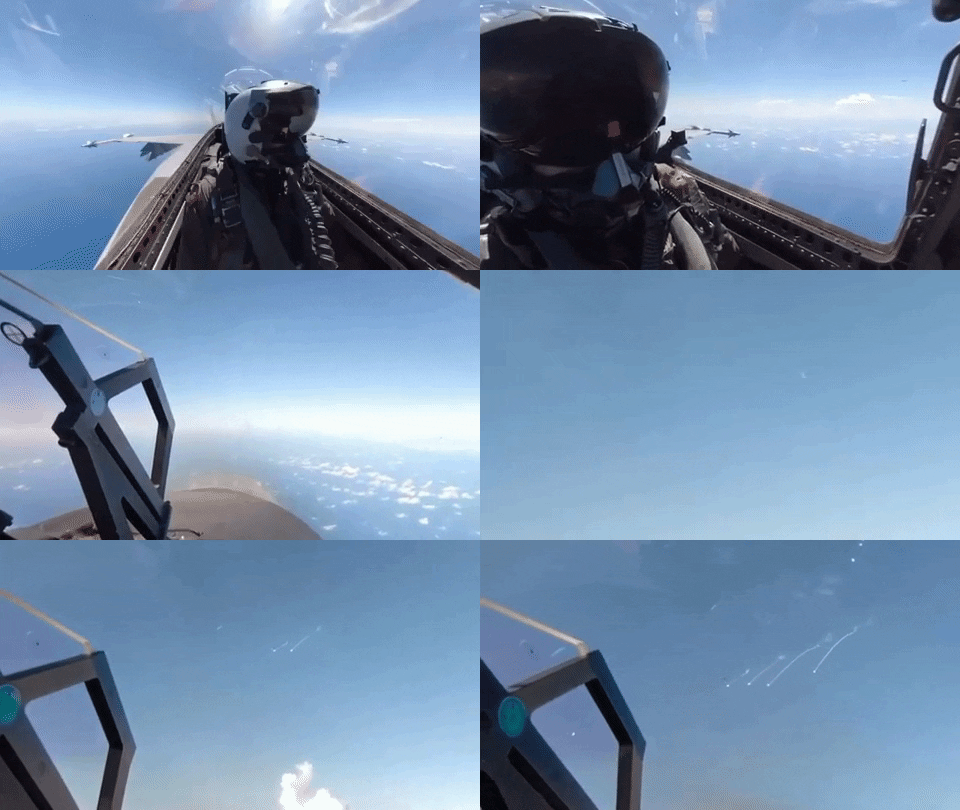
Last month, an F-16 took off from Eglin Air Force Base in Florida. There was a pilot in the seat. The AI was flying the plane.
This is not a simulation. It is not a test drone in a controlled lab. It is a standard combat-ready F-16, the same model already in service across the U.S. Air Force fleet, flying autonomous missions over American airspace. The human in the seat had one job: watch, and take over if something went wrong.
What Actually Happened
DARPA and the U.S. Air Force have been running a program called VENOM, short for Viper Experimentation and Next-generation Operations Model. The idea is straightforward: take a standard F-16, bolt on an AI kit, and let the AI fly it.
The modification is called the VENOM Autonomy Kit. It interfaces with the jet's existing flight controls without touching the core software. A pilot can flip a switch and hand control to the AI. Flip it back, the pilot has the jet again. The first human-on-the-loop autonomous flights began in July 2026 at Eglin Air Force Base.
DARPA calls this a safe, reliable environment for human-on-the-loop experimentation. That phrase is doing a lot of work. It means the human is present and can intervene. But the AI is making the moment-to-moment decisions.
Why This Is Different from a Drone
A drone has no human onboard. It is either remotely piloted or pre-programmed, and a human somewhere is usually approving significant actions before they happen.
The VENOM F-16 is different. It is a combat-grade aircraft, capable of air-to-air combat, flying with an AI in control of the jet while a human monitors from inside the cockpit. The distinction matters because this technology is designed to scale. DARPA's next program, called AIR (Artificial Intelligence Reinforcements), will test multiple AI agents on multiple aircraft at once. The goal is not one AI-piloted jet. It is one human pilot commanding a team of autonomous jets, with the AI making decisions faster than any human can process.
The program is explicitly designed for beyond-visual-range combat, meaning situations where aircraft are too far apart and moving too fast for a human in the loop to meaningfully participate in individual decisions.
The Question Nobody Wants to Answer
The question people keep asking is whether AI can fly a plane. It can. That has been clear since at least 2023, when an AI agent defeated a human pilot in a simulated dogfight.
The question that nobody is answering cleanly is what happens when the AI has to decide whether to fire a weapon. In beyond-visual-range combat, at the speeds and distances involved, there may not be time for a human to review and approve the decision. The human is technically on the loop, but the loop may be moving faster than any human can follow.
Military officials have said publicly that lethal decisions will always require human authorisation. The technology they are building is designed for a world where that becomes increasingly difficult to guarantee.
Over to You
The U.S. Air Force is building a system where AI pilots lead formations of jets in combat, with humans monitoring rather than controlling. The technology is already flying. The rules about when an AI can act without human approval are still being written.